
Fine Arts is the expression or application of human creative skill and imagination, typically in a visual form such as painting, drawing or sculpture, producing works to be appreciated primarily for their beauty or emotional power. Arts can also be perceived by the creative activities when producing music, oratory or dancing.
The interpretation of fine arts is highly subjective and depends on the beholder, who brings their own perspective and emotions to the artwork.
There are several attributes such as colors, sounds, and curves etc. that qualifies fine arts especially when it comes to mesmerizing, attracting and stimulating the thoughts of appreciating these visual and listen aspects of arts in general.
| Interpretation of arts is very powerful and is dependent to the beholder who is the interpreter of the artwork. Artwork should not be limited to just paintings, drawings or sculptures; it extends to music as well as dancing. | There is always several interpretations from a group of artists when presented with a piece of artwork for each one to uniquely, narrate and present what they think about that particular artwork. | The medium used for producing the art piece is important, family of colors and finishing gives an ideal of the state of that artist which can be included as part of the interpretation of the art piece. |
The interpretation of art is a powerful process that relies on the beholder, who serves as the interpreter of the artwork. Art should not be confined to paintings, drawings, or sculptures; it also encompasses music and dance.

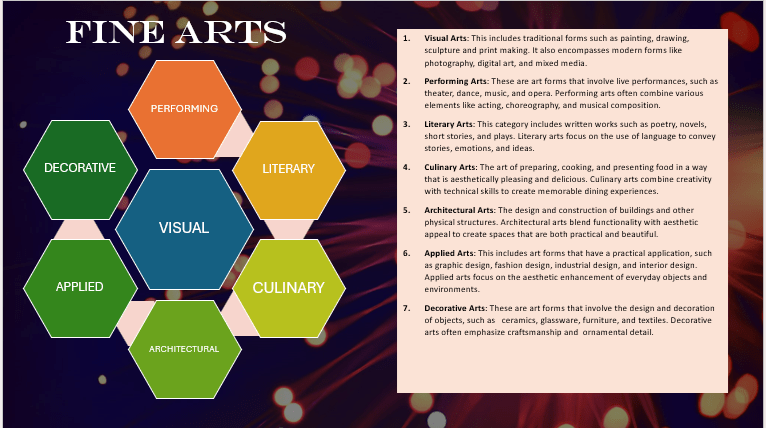
Fine arts encompass a wide range of creative disciplines that are primarily appreciated for their beauty, emotional power, and intellectual stimulation. Here are the main categories of fine arts:
Visual Arts: This includes traditional forms such as painting, drawing, sculpture, and printmaking. It also encompasses modern forms like photography, digital art, and mixed media.
Performing Arts: These are art forms that involve live performances, such as theater, dance, music, and opera. Performing arts often combine various elements like acting, choreography, and musical composition.
Literary Arts: This category includes written works such as poetry, novels, short stories, and plays. Literary arts focus on the use of language to convey stories, emotions, and ideas.
Culinary Arts: The art of preparing, cooking, and presenting food in a way that is aesthetically pleasing and delicious. Culinary arts combine creativity with technical skills to create memorable dining experiences.
Architectural Arts: The design and construction of buildings and other physical structures. Architectural arts blend functionality with aesthetic appeal to create spaces that are both practical and beautiful.
Applied Arts: This includes art forms that have a practical application, such as graphic design, fashion design, industrial design, and interior design. Applied arts focus on the aesthetic enhancement of everyday objects and environments.
Decorative Arts: These are art forms that involve the design and decoration of objects, such as ceramics, glassware, furniture, and textiles. Decorative arts often emphasize craftsmanship and ornamental detail.
These categories highlight the diverse ways in which human creativity and imagination can be expressed and appreciated.

 DAVFLY