
Demand and Supply and its effects on Building Materials and the influence on the construction Industry.
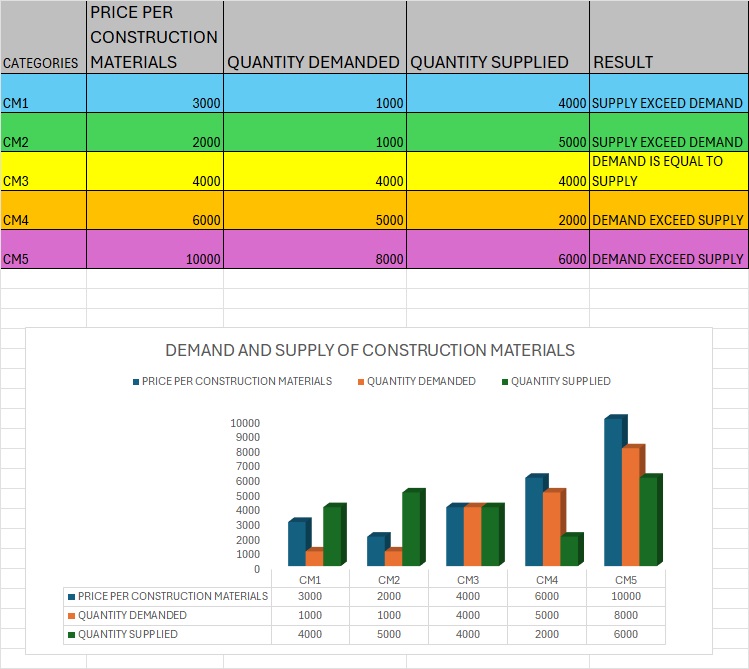
Studies reported by business wire news evaluated several construction distributing markets and notice a huge rise in demand of commercial and residential buildings including newly land development projects set to take-off to support the demand. With a rise in DEMAND, the price factors will dramatically decrease due to the high volume of materials (SUPPLY) needed to meet the demand.
Industry Forecast
Economic growth and rising population impact on the construction materials market, and profitability will be curbed by high-energy prices. Economic slowdown is also likely to cut profit as companies absorb input costs they can pass on in a stronger economic climate.
Areas of innovation in the building materials industry include specialty materials, such as those used in storm rooms to provide shelter during extreme weather conditions. Much development is being carried out to limit thermal loss from residential buildings to boost energy efficiency. In addition, environmental regulations pertaining to building requirements and the need to cut energy costs will continue to fuel market growth, with smart and go-green buildings set to see substantial expansion.
The construction building materials market is expected to grow at more than 6% yearly through 2015 to reach almost $890 million, according to business wire. The industry encompasses cement, brick, concrete, sand, aggregates and gravel manufacturers. Cement manufacturing was the most dynamic market segment in 2010, reaching close to $200 million, or nearly a third of the overall global market. Among the most-used building materials such as steel, glass, wood, plastics and cement commonly found in chain building stores such as HOME Depot Inc. HD. The industry segment is related to wiring and furniture manufacturers.
The building materials market is fueled in a large part by go-green building, with this market segment worth over $60 million in the US. Go-Green building is particularly popular in the residential market, led by demand of products such as cork, bamboo and woven flooring. Concrete production from recycled materials is also a dynamic growth area within the industry, along with wood from sustainable forests, energy-efficient lighting fixtures and water-efficient plumbing fixtures.
Environmental Factor
The go-green construction materials market is expected to exceed $405 million by 2015, according to Global Industry Analysts. Factors fueling go-green building include falling go-green building material costs, energy costs, decreasingly protective environmental legislation and general consumer awareness of environmental factors. The market will continue to expand because of consumer preference for go-green alternatives and pressure to optimize energy efficiency.
The EU is the leading region in the go-green building materials market, followed by the US. Emerging markets are expected to show stronger growth, with Asia-Pacific taking the lead. Rising living standards, environmental concern, falling costs and lesser efficiency will all drive the go-green building materials market. Go-Green floor coverings represent the fastest-growing segment, with go-green concrete following the roofings. Go-Green flooring materials include bamboo, hardwood, corks and ceramic tiles. Residential buildings represent the biggest market for go-green construction materials, with the non-residential buildings market following suit.
Key Market Segments
Construction Materials Demand and Supply
The hydraulic cement markets are expected to rise more than 4% yearly to 3.5 million metric tons, representing overall worth in excess of $245 million by 2029, according to Business wire news. Emerging markets will see growth fueled by infrastructure investment while developed countries will experience slower growth. Ready-mix concrete will remain the most dynamic growth sector through 2029, with blended cement gaining market share through 2029. China, which currently represents around 50% of global demand for cement, will see growth slow through 2029; EU will see rapid growth.
•The drywall markets are expected to grow more than 2.5% in the next 4 years to over 20 million square meters, according to Business wire. Combined, the US and Asia-Pacific will represent around 60% of new product demand through 2029, with the US seeing 2% yearly growth. Growing populations and urban housing demand will make Asia-Pacific the fastest-growing market in the next four years.
•Demand for gypsum-based building plasters is expected to level off in the next 5 years.

 DAVFLY