
The president explicitly conditioned the relief on the success in this month’s elections of the Argentine leader, who admires and emulates him.
President Donald Trump on Tuesday touted a $20 billion foreign bailout that he acknowledged would not primarily serve American interests, testing his leeway with his own “America First” motto and in particular the patience of domestic farmers who have yet to receive their own relief from Trump’s trade war.
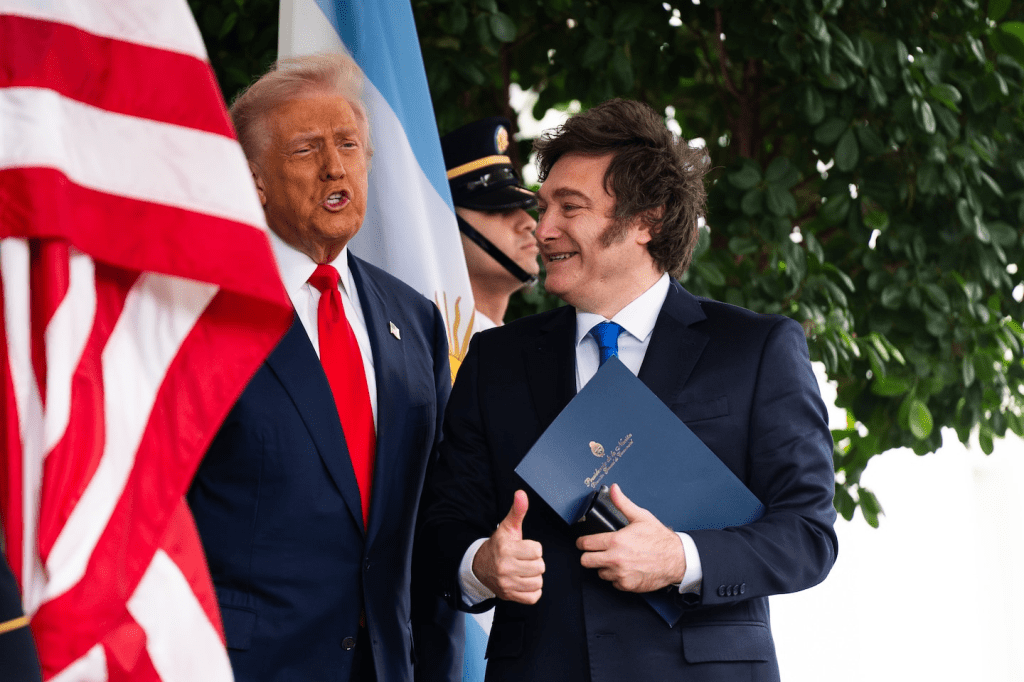
By his own account, Trump is offering $20 billion to Argentina to help its politically aligned president, Javier Milei, who faces a possible financial crisis and a legislative election Oct. 26.
“We don’t have to do it. It’s not going to make a big difference for our country,” Trump told reporters over lunch with Milei at the White House on Tuesday. “The election is coming up very soon. Our approvals are somewhat subject to who wins the election.”
Later, asked directly if the rescue was meant to help Milei’s party in the election, Trump said, “It’s really meant to help a good financial philosophy.” Still, he explicitly conditioned the money on Milei’s success and formally endorsed him.
The bailout had drawn criticism from Sen. Chuck Grassley (R), who represents the major farming state of Iowa and noted that Argentina competes with American soybean farmers for global exports. In a Sept. 25 social media post, Grassley said the administration should be supporting American farmers instead.
Trump addressed the competition Tuesday, accusing China of trying to drive a wedge between the U.S. and Argentina by buying Argentina’s soybeans rather than those grown in the United States.
But he also said: “It’s not going to mean anything in the end.”
Treasury Secretary Scott Bessent also emphasized the political dimensions of the bailout, sniping at left-wing U.S. politicians and accusing the Obama administration of neglecting center-right governments in South America.
“There’s a midterm election coming up. We think he’s going to do well and then continue his reform agenda,” Bessent said of Milei. “We’ve been criticized by a couple of American Peronists,” he added, referring to the 20th-century Argentine populist movement led by Juan Perón.
Milei thanked Trump for “understanding the threat that socialism represents” in Latin America and blamed his country’s economic conditions on “the opposition’s attacks.” Milei, 54, has loudly admired Trump and emulated his MAGA formula — including the acronym itself, swapping in Argentina for the first A.
The Argentine president attended a gala at Mar-a-Lago after Trump’s reelection and spoke at the Conservative Political Action Conference near Washington in February. There, he gave a chainsaw to Elon Musk as a tribute to his government cuts through the U.S. DOGE Service.
Trump has been unusually willing to intervene in foreign elections, endorsing allies with whom he shares a nationalist worldview. He backed Hungarian Prime Minister Viktor Orban ahead of 2022 balloting and hosted Karol Nawrocki, a right-wing candidate for the Polish presidency, in the Oval Office in May, weeks ahead of his country’s close election. Nawrocki won.
Secretary of State Marco Rubio has made Latin America a major focus of his diplomacy, visiting the region repeatedly after it was subject to relative neglect by the Biden administration. Rubio, a Cuban American from Florida, has long been attuned to ties to Latin America and has said that he wants to build close relations to governments there.
U.S. governments have bailed out Latin American economies in the past, sometimes directly and sometimes via the International Monetary Fund, which the U.S. government backs. Bailouts typically come with tight fiscal demands attached to them, with the goal of preventing future economic problems.
Supporters of bailouts say that though they may come at a short-term cost to the international institutions or governments that are offering support, they are worthwhile in the long run to promote global economic stability.
Trump campaigned on prioritizing U.S. interests in world affairs, and his administration has slashed foreign aid to the point of withholding congressionally authorized funds.
U.S. presidents have long been cautious about endorsing specific foreign leaders ahead of elections, mindful that they will need to work with whomever is victorious. At the same time, White House occupants have a long history of engaging in the politics of other nations, sometimes at the ballot box and sometimes through force.
The CIA has admitted to backing the coup that installed the shah of Iran in 1953 and has a long history of involvement in supporting armed forces in Latin America that opposed Soviet-aligned leaders during the Cold War.
More recently, President Barack Obama jumped into the 2016 British referendum about withdrawing from European Union membership, declaring that Britain would be at the “back of the queue” for a trade deal with the United States should it split from the bloc. Britain ultimately voted to exit the European Union, depriving Washington of its main eyes and ears in the economic bloc.

 DAVFLY