
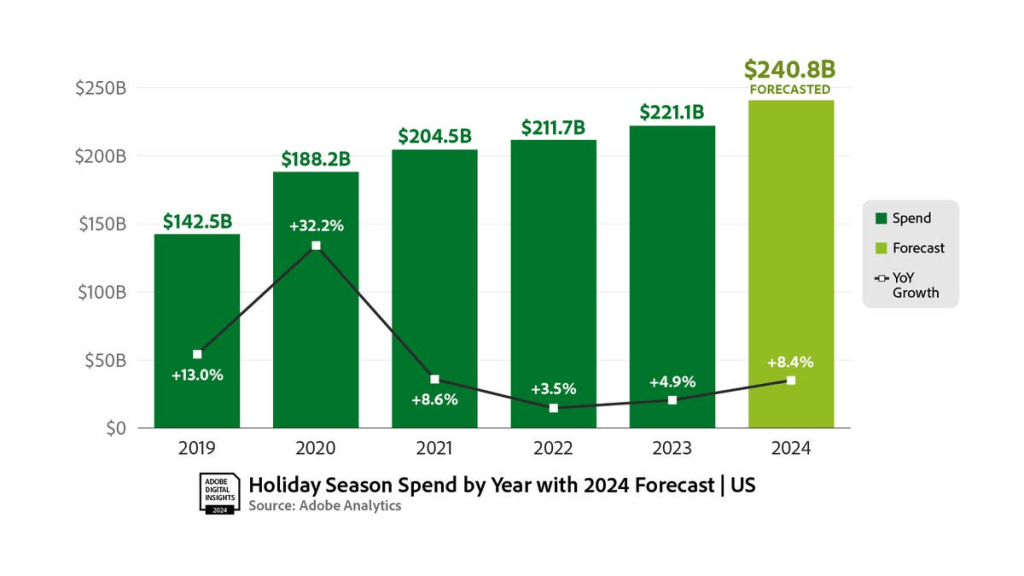
According to Adobe Analytics data for Nov. 1-24, U.S. consumers have spent $77.4 billion online, up 9.6% year-over-year and trending above Adobe’s full holiday season forecast of 8.4% year-over-year growth. Out of the first 24 days, Adobe has tracked 21 days so far as seeing consumers spend more than $3 billion online in a single day (up from 16 days in the same period in 2023).
Forecast for Cyber Week
Cyber Week (the five-day period including Thanksgiving, Black Friday and Cyber Monday) is expected to drive $40.6 billion in online spend, up 7% year-over-year and representing 16.9% of the overall holiday season.
Adobe predicts that Cyber Monday (Dec. 2) will remain the biggest shopping day of both the holiday season and the year, driving a record $13.2 billion in spend, up 6.1% year-over-year.
Black Friday, Nov. 29 ($10.8 billion, up 9.9% YoY) and Thanksgiving Day, Nov. 28 ($6.1 billion, up 8.7% YoY) are both expected to outpace Cyber Monday in year-over-year growth, as consumers embrace earlier deals promoted by U.S. retailers.
Adobe figures are not adjusted for inflation, but if online deflation were factored in, the company says growth in consumer spend would be even stronger.
“The holiday season is off to a strong start, and we see a consumer willing to splurge on more expensive items in categories from electronics to appliances, partly in response to persistent discounts,” said Vivek Pandya, lead analyst, Adobe Digital Insights. “Shoppers are also embracing new ways to shop online this season, from the rise in mobile shopping that will again eclipse desktop, to the use of generative AI-powered chat bots as a shopping assistant.”
Adobe Analytics data covers more than 1 trillion visits to U.S. retail sites, 100 million SKUs, and 18 product categories. Adobe Analytics is part of Adobe Experience Cloud.
At the category level, Adobe says U.S. consumers have spent the most on electronics so far, coming in at $17.7 billion (up 11.4% year-over-year). Two categories have outpaced electronics in terms of year-over-year growth, including apparel ($14.5 billion, up 13.4% year-over-year) and grocery ($7.5 billion, up 16.8% year-over-year).
Other categories with notable year-over-year growth include furniture/bedding ($9.5 billion, up 7.2% year-over-year) and cosmetics ($3.2 billion, up 10.1% year-over-year).
Mobile shopping surges
In the first 24 days of November 2024, 51.6% of online spend (up from 49.5% in the comparable period last year) happened through a mobile device, representing $39.9 billion in online spend, up a significant 13.3% year-over-year. Adobe forecasts mobile spending will a record $128.1 billion for the full holiday season at 12.8% year-over-year growth.
During the same period, curbside pickup accounted for 15.9% of orders for retailers who offer the service. This is down from 17.5% share in the comparable period in 2023. Adobe expects usage of curbside pickup will increase in December, as consumers leverage it to avoid shipping delays and cut down on costs in some cases.
Also In the first 24 days of November, the flexible buy now pay later (BNPL) payment method has driven $5.7 billion in online spend, up 3.6% year-over-year. This represents $200 million more than the comparable period in 2023. Adobe expects BNPL usage to ramp up during Cyber Week and hit a new record on Cyber Monday ($993 million, up 5.6% year-over-year). BNPL has also been predominantly driven by mobile shopping, with its share of spend hitting 79.1% so far this season.
Record E-commerce Spend in the U.S.
Adobe expects U.S. online sales to hit $240.8 billion this holiday shopping season (Nov. 1 to Dec. 31), representing 8.4% growth year-over-year (YoY). In the 2023 season, shoppers spent $221.8 billion online at 4.9% growth YoY. Shopping on mobile devices is expected to hit a new milestone, contributing a record $128.1 billion and growing 12.8% YoY. This would represent a 53.2% share of online spend this season (versus desktop shopping).
Cyber Week (the 5-day period including Thanksgiving, Black Friday and Cyber Monday) is expected to drive $40.6 billion in online spend, up 7.0% YoY and representing 16.9% of the overall holiday season. Adobe expects Cyber Monday will remain the season’s and year’s biggest shopping day, driving a record $13.2 billion in spend, up 6.1% YoY. Black Friday ($10.8 billion, up 9.9% YoY) and Thanksgiving Day ($6.1 billion, up 8.7% YoY) are both expected to outpace Cyber Monday in growth YoY, as consumers embrace earlier deals promoted by U.S. retailers. In a survey of 5,000 U.S. consumers**, 71% say they plan to shop online on Black Friday, with 70% saying they proactively check for deals during Cyber Week.
“The holiday shopping season has been reshaped in recent years, where consumers are making purchases earlier, driven by a stream of discounts that has allowed shoppers to manage their budgets in different ways,” says Vivek Pandya, lead analyst, Adobe Digital Insights. “These discounting patterns are driving material changes in shopping behavior, with certain consumers now trading up to goods that were previously higher-priced and propelling growth for U.S. retailers.”
Price Sensitive Shoppers Enticed by Strong Discounts
Adobe anticipates major discounts this season–up to 30% off listed prices–as retailers compete for consumer dollars. These levels are on par with the 2023 season. Of the 18 categories tracked by Adobe, discounts for electronics are expected to peak at 30% off listed price (vs. 31% in 2023) while discounts for toys are set to hit 27% (vs. 28%). Record high discounts are expected for TVs at 24% (vs. 23%) and sporting goods at 20% (vs. 18%). Other categories with notable discounts include apparel at 23% (vs. 24%), computers at 23% (vs. 24%), furniture at 19% (vs. 21%) and appliances at 18% (vs. 18%).
Each season, discounting has been a reliable driver of consumer demand and e-commerce growth for retailers. The effect has been more pronounced in 2024 as consumers remain price sensitive, taking advantage of big promotional events after a period of persistent inflation. This year, Adobe’s data showed that for every 1% decrease in price during promotional events (Prime Day, President’s Day, Memorial Day and Labor Day), demand increased by 1.025% compared to the year prior. This drove an incremental $305 million in online spend. For the upcoming holiday season, Adobe expects the strong consumer response to discounts will contribute an incremental $2 billion to $3 billion in online spend—a figure factored into the record $240.8 billion spend forecasted for e-commerce.
Shoppers “Trading Up” for the Holiday Season
Prior to the holiday season, months of persistent inflation had led shoppers to embrace cheaper goods across major e-commerce categories. To conduct this analysis for each category tracked by Adobe, prices were separated into four quartiles from the highest to lowest prices. Shares of units sold in the most expensive and least expensive quartiles were then tracked from April 2019 to August 2024. Adobe found the share of the cheapest goods increased significantly, up 46% across categories. Conversely, share of the most expensive goods decreased by 47% in the same period.
The trend is expected to reverse for the upcoming holiday season, where share of the most expensive goods is set to increase by 19% compared to pre-season trends—driven in large part by competitive discounts. This effect is particularly strong in categories including sporting goods, where share of the most expensive goods is expected to rise by a staggering 76%. Other categories with the same trend include electronics (up 58%) and appliances (up 40%). Adobe sees a more modest rise in apparel (up 3%) and toys (up 3%). Categories with a drop include furniture/bedding (down 12%) and groceries (down 3%), as consumers embrace lower-priced products.
Consumer Guide: Best Time to Shop
The deepest discounts are expected to hit during Cyber Week, the best time to shop for bargain hunters. And across several categories, the best deals are set to happen before the big Cyber Monday event. Thanksgiving Day (Nov. 28) will be the best day to shop for toys, appliances, furniture and sporting goods. On Black Friday (Nov. 29), shoppers will see the deepest discounts for TVs. The Saturday after (Nov. 30) will have the best deals for computers. And Cyber Monday (Dec. 2) will be the best day to shop for electronics and apparel—the two biggest categories in e-commerce by revenue share.
Notably, consumers will see deals beginning in mid-October with the Prime Day event expected to drive discounting across major U.S. retailers, up to 16% off listed price. Discounts are set to ramp up again beginning Nov. 1 and through Nov. 21, up to 18% off listed price. This provides consumers some flexibility in managing their budgets. Even after Cyber Week, discounts are expected to linger through the month of December, up to 15% off listed price.
Social Influencers Driving Consumers to Shop
Across major marketing channels, paid search has remained the top driver of retail sales (28% share of online revenue from Jan. 1 to Sept. 3, 2024) and is expected to grow by 1% to 3% during the holiday season. The fastest growth is set to come from affiliates and partners (17.2% share)—which includes social media influencers—at 7% to 10%. This channel is also expected to outpace retailer traffic from social media overall (nearly 5% share), where growth is at 4% to 7%. In 2024, Adobe’s data showed that influencers are converting shoppers (individuals making a purchase after seeing influencer content) 10 times more than social media overall. This is expected to hold strong during the holiday season. In Adobe’s survey, 37% of GenZ respondents have purchased something based on an influencer’s recommendation.
Contributor: Zee Said

 DAVFLY