
Hurricane Hilary headed for Mexico’s Baja California Saturday as the U.S. National Hurricane Center predicted “catastrophic and life-threatening flooding” for the peninsula and for the southwestern United States, where it is forecast to make landfall in Southern California as a tropical storm on Sunday.
Officials in Los Angeles scrambled to get homeless people off the streets and out of riverbeds, set up shelters and prepare for evacuations. With a tropical storm watch ratcheted up to a warning on Friday night, shoppers crowded into supermarkets and hardware stores to stock up on food and supplies. Festivals, ballgames and special events were canceled, parks and beaches were being closed, and officials warned against pursuing such ordinary weekend pastimes as hiking or camping.
Hilary was expected to plow into the Mexican peninsula on Saturday night and then surge northward and enter the history books as the first tropical storm to hit Southern California in 84 years.
The tropical storm warning – a first-ever for the region – was issued Friday night for a wide swath from the Pacific coast to interior mountains and deserts. On Saturday, officials urged residents and visitors to flee Catalina Island, and parts of San Bernardino County hobbled by the ravages of previous storms saw evacuation warnings.
“I don’t think any of us — I know me particularly — never thought I’d be standing here talking about a hurricane or a tropical storm,” said Janice Hahn, chair of the Los Angeles County Board of Supervisors.
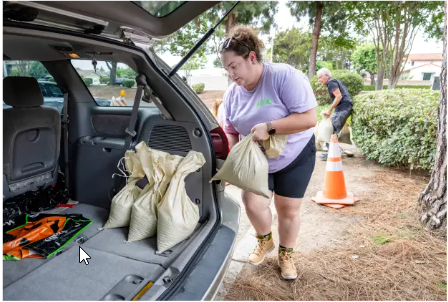
Madison Clark loads sand bags into the back of a van at Columbus Tustin Park in Tustin on Saturday afternoon, August 19, 2023, in preparation for the landfall of Hurricane Hilary. According to the National Weather Service, there has not been a tropical storm making landfall in Southern California since September 1939. (Photo by Mark Rightmire, Orange County Register/SCNG)
Tropical force winds could arrive in the region around 8 a.m. Sunday and peak in the afternoon and evening before tailing off into Monday, said Ryan Kittell, a NWS meteorologist in Oxnard.
“We’re pretty confident on these winds,” he said, “but there’s still a little uncertainty based on the track of the storm which areas will be strongest.”
The heaviest rain for most of Southern California is anticipated between noon Sunday and midnight, the NWS said.
The region’s beaches are expected to see massive waves starting Sunday as winds begin to buffet the area: In Newport Beach and Huntington Beach in Orange County, and in Cabrillo Beach, the Palos Verdes Peninsula and Zuma Beach in Los Angeles County, waves are expected to rise to eight to 10 feet tall late Sunday into Monday morning. At the Wedge in Newport Beach, bigger sets could reach up to 15 and even 20 feet.
“Large swells are likely to cause life-threatening surf and rip current conditions to Southern California,” the National Weather Service posted on Twitter on Saturday morning. Beach erosion is another concern.
Heavy rain is likely to lead to flash flooding in some mountain and foothill areas, along with powerful winds Sunday into Monday.
Flooding might prompt evacuation orders, with the rain turning small streams, creeks, canals, arroyos, and ditches into “dangerous rivers,” leading to potentially destructive runoff in mountain valleys that could raise the risk of rock slides, mudslides and debris flows. Driving conditions could be hazardous and potentially mean road and bridge closures.
On Saturday, evacuation orders were issued in San Bernardino County for Oak Glen, Forest Falls, Mountain Home Village, Angelus Oaks and Northeast Yucaipa.
Click here to see a map of the evacuation area.
Areas of Forest Falls and Oak Glen were evacuated in September last year after Tropical Storm Kay caused mudslides that destroyed 30 homes and killed a woman found days later buried under debris.
Warnings were also issued Saturday afternoon for Silverado and Williams canyons in Orange County, which sit near the Bond fire burn scar, officials said. Those with disabilities or large animals were urged to consider voluntarily evacuating Saturday afternoon.
A shelter was planned to open at 7:30 p.m. at the Norman P. Murray Community and Senior Center in Mission Viejo, 24932 Veterans Way.
“We did have a decaying Tropical Storm Kay that caused extensive damage,” said Karla Nemeth, director of the California Department of Water Resources. “This storm, Hurricane Hilary, is anticipated to be stronger than that.”
Also, Gov. Gavin Newsom proclaimed a state of emergency for much of Southern California to support Hurricane Hilary response and recovery efforts. A statement from his office said “there are currently more than 7,500 boots on the ground deployed to help local communities protect Californians from the impacts of Hurricane Hilary.”
Lisa Griggs, a 50-year-old entrepreneur who lives in Lake Arrowhead, was preparing for the storm on Saturday by filling sandbags, securing patio furniture, making sure she had flashlights and candles and getting gas for a generator.
After the severe blizzard in the San Bernardino mountains this winter, Griggs said, she is more wary of getting timely help from officials and keener on being self-sufficient.
“Until I’d gone out to the store and started talking to everybody about the storm, I was feeling pretty good about it,” Griggs said with a laugh. But, she added, “I want to be as prepared as I can be. I made sure the cat carriers are together and that we have extra dog food, in case we have to evacuate.”
In Catalina, residents were being advised to leave the island as a precaution and Long Beach officials were setting up a temporary shelter at Silverado Park, at 1545 W. 31st St., to accommodate Catalina residents who have left the island and don’t have any other shelter plans, city officials said.
The shelter was set up to accommodate up to 75 people and will provide food, water, beds and basic medical services, city officials said. The Silverado Park shelter is for residents of Catalina Island only.
On Saturday afternoon, Hilary was bumped down to a Category 2 hurricane, its strength diminishing as it headed north, the NWS reported. Later Saturday, it was downgraded to Category 1.
“They need a lot of moist air and do not do well with a lot of terrain,” NWS meteorologist Elizabeth Adams said in a late Saturday afternoon update. “Dry air to the west and interacting with the landmass that is Baja California, that is leading to the weakening of Hurricane Hilary we are seeing right now.”
Nevertheless, state officials urge Southern California residents to stay home during the storm and postpone any non-essential travel. They also warned of possible evacuations due to flooding and power outages.
“Make no mistake, there will be power outages across Southern California,” said Nancy Ward, director of the California Governor’s Office of Emergency Services. “We want to be sure we have this close communication with those utility companies to ensure they can restore power as quickly as they can.”
State officials said resources have been pre-positioned in an attempt to combat the effects of flooding, but urged residents to have a go-bag ready in the event of an evacuation. They also urged residents to check on their neighbors, family and friends, especially those who are older, to make sure they have what they need to evacuate or shelter in place.
Col. David Kauffman of the California Military Department said 22 high-water vehicles were pre-positioned and the California National Guard has soldiers and airmen on standby to respond should the need arise.
Tony Tavares, director of Caltrans, said resources and employees have been pre-positioned for quick response to storm-related trouble on the roadways and that roadways may be closed due to flooding.
“Please, if you encounter a roadway that’s flooded, absolutely do not attempt to pass through that roadway,” CHP Assistant Commissioner Ceto Ortiz said. “Signs and barricades are there for a reason – for you to be safe. Do not try to go around them.”
After rapidly gaining power early Friday, Hilary slowed some later in the day but had remained a major Category 4 hurricane early Saturday with maximum sustained winds of 130 mph, down from 145 mph.
At one point Saturday, the hurricane was centered about 240 miles west-southwest of the southern tip of the Baja peninsula. It was moving north-northwest at 13 mph and was expected to turn more toward the north and pick up speed.
It was expected to make landfall along a sparsely populated area of the Baja peninsula at a point about 200 miles south of Ensenada. It was then forecast to continue northward, raising fears that its heavy rains could cause dangerous flooding in the border city of Tijuana, where many homes in the city of 1.9 million cling precariously to steep hillsides.
Concerns rose in California and southern parts of Nevada, too.
The National Park Service closed Joshua Tree National Park and Mojave National Preserve to keep people from becoming stranded amid flooding.
Many state and county beaches in the region also closed, along with many parks.
Cities across the region, including in Arizona, were offering sandbags to safeguard properties against floodwaters.
Major League Baseball rescheduled three Sunday games in Southern California, moving them to Saturday as part of split-doubleheaders.
And the popular the Festival of Arts of Laguna Beach announced it will temporarily close its fine art show and cancel Pageant of the Masters performances on Sunday and Monday.
Deputies with the Los Angeles Sheriff’s Department took to the road to urge homeless people living in riverbeds to seek shelter. Authorities in the city were arranging food, cots and shelters for people who needed them.
SpaceX delayed the launch of a satellite-carrying rocket from a base on California’s central coast until at least Monday. The company said conditions in the Pacific could make it difficult for a ship to recover the rocket booster.
President Joe Biden said the Federal Emergency Management Agency had pre-positioned staff and supplies in the region.
“I urge everyone, everyone in the path of this storm, to take precautions and listen to the guidance of state and local officials,” Biden told reporters Friday at Camp David, where he was meeting with the leaders of Japan and South Korea.
Los Angeles Mayor Karen Bass said she received a call from Secretary of Homeland Security Alejandro Mayorkas to let her know he will be available 24/7 as the city weathers the storm. The city has federal support on hand “should we need it,” she added.
The state’s Emergency Management Department will activate its Emergency Operation Center to monitor and manage any incidents and impacts on the city, as well.
“311 will be expanding operating hours if there is a high call volume. LAFD Fire Chief (Kristin) Crowley will oversee the Emergency Operations Center,” Bass said.
Officials said the storm could bring heavy rainfall to most of the southwestern United States, dumping 3 to 6 inches in places, with even more in isolated amounts in parts of southern California and southern Nevada.
“Two to three inches of rainfall in Southern California is unheard of” for this time of year, said Kristen Corbosiero, a University of Albany atmospheric scientist who specializes in Pacific hurricanes. “That’s a whole summer and fall amount of rain coming in probably 6 to 12 hours.”

 DAVFLY